
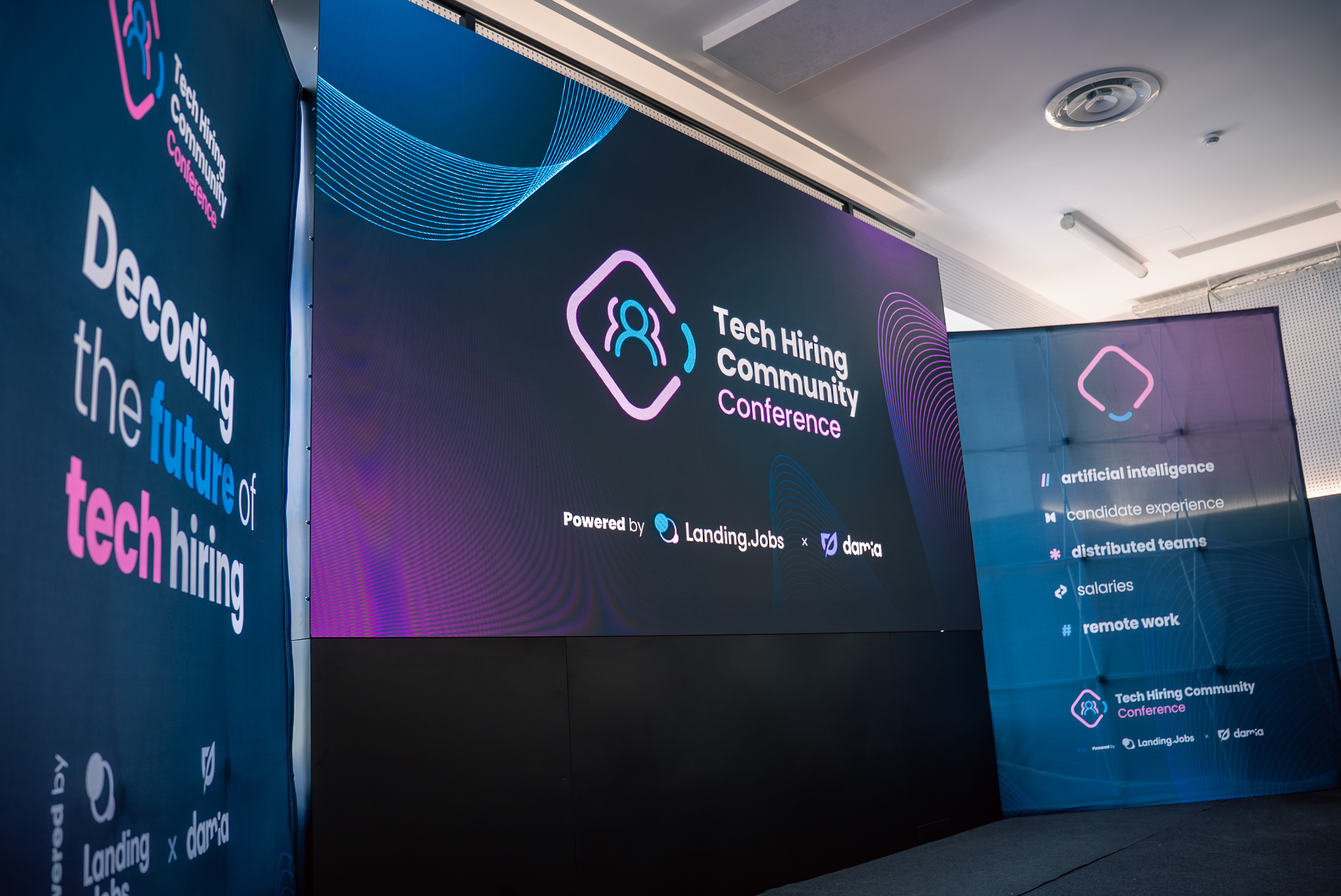

The 2026 Tech Hiring Community Conference brought together recruitment, engineering, product and strategy professionals from a wide range of companies. These include SAP, Zendesk, Make, Sword Health, Microsoft, Eventbrite, Thumbcorp, Defined.ai, Centric Software and Auto Europe, among others.
The main themes were unavoidable: recruitment, sourcing, AI. What made the day interesting was the willingness to discuss honestly what is failing, changing and still irreplaceable.
AI in recruitment: what’s working and where the risks are
AI adoption in hiring is real and accelerating. Automatic summarisation of interviews, CV screening, generating target company lists, market salary analysis, intelligent scheduling, candidate feedback synthesis. All of this is already happening, with measurable time savings. What used to take hours now takes minutes.
But maturity is far from uniform. There is a significant difference between using AI as an assistant and delegating decisions to it.
The line that should not be crossed is using AI to generate candidate shortlists without genuine, direct human oversight. The cost savings are real, the quality of the process not always.
Healthy scepticism also has its place: Automated, AI-personalised messages are useful as a starting point, but candidates recognise them. Most developers already use AI tools in their daily work, with GitHub Copilot, Claude and ChatGPT topping the list, which means recruitment teams need to understand these tools in order to properly evaluate the people who use them.
Allowing AI in technical interviews
One of the most counterintuitive ideas of the day: allowing candidates to use AI during technical challenges may, in fact, be one of the best ways to assess genuine competence.
When candidates use AI without discernment (accepting outputs without reviewing them, unable to explain what the code does, failing to ask the right questions of the model) this reveals exactly what a good hiring process needs to know.
On the other hand, there are those who use AI as a reasoning tool, questioning outputs, seeking context, taking ownership of the result. The latter demonstrate the kind of thinking that matters in a candidate, and continue to evidence strong reasoning and critical thinking skills.
The practical conclusion: banning AI from interviews in 2026 could reasonably be called organisational hypocrisy. Companies say they want people with AI literacy, then penalise those who use it during the process. It is a contradiction that risks losing strong candidates.
Hiring processes haven’t kept up with how roles have changed
The software engineer role has changed radically over the past 10 years.
It has evolved from a profile centred on pure technical knowledge to one that also requires communicating with non-technical stakeholders, thinking about business impact, working in ambiguous contexts, and adapting to new tools constantly. Hiring processes, at most companies, have not kept up.
Multiple technical rounds and exercises disconnected from the reality of the job assess something AI already does rather well: memorising algorithms and pre-built solutions.
What AI cannot do is carry the context of a business, understand the real trade-offs of a technical decision, or ask the right questions when a problem is not yet well defined.
The alternative exists: real business case challenges, clear evaluation rubrics, fewer rounds with higher quality. And the courage to make a decision in 2 rounds rather than 7.
What tech candidates expect from employers
Younger generations entering the workforce do not simply want a job. They want clarity about location, about the company’s direction, about what they will learn. They want transparency in the recruitment process and to know If there’s life beyond work.
“Work is no longer their identity” This sentence captures the changes well. Job descriptions need to reflect that with more transparent descriptions of day-to-day reality and the company offer in terms of growth perspectives.
Academic degrees continue to lose ground. What matters is potential, skills, the capacity for continuous learning, and AI literacy, which is itself a moving target. Someone “AI fluent” today may be out of date in 6 months, what does not change is the ability to learn quickly.
Stability has grown in importance. After years of more frequent job-switching, there is growing demand for environments where people can put down roots, not meaning stagnation, but the sense that the company is investing in them.
Understanding what talent wants means understanding what the future holds for companies. This year, Landing.Jobs and Damia created the most comprehensive report yet seen. It’s based on the expectations tech talent revealed in interviews and real data from current tech employees. This analysis resulted in a detailed report full of insights that will help the market make more informed, data-driven decisions: Tech Talent Trends report 2026.
Employer branding: attracting talent before the job opening
The best candidates do not apply. They choose. And they choose based on 3 things: a brand they trust, leaders they follow, and teams they want to be part of.
This means employer branding does not start with the job opening, it starts much earlier. It’s not defined in a single moment. It’s constant, built every day, by the whole organisation and external presence. The perception a candidate has of a company before they ever see a job opening determines whether they will even open a recruiter’s email.
There are 3 key points:
- Building a mission that is bigger than the company itself (and genuine enough to attract people who believe in it);
- Creating a new category that makes people want to be part of something still being invented;
- Or investing in the personal brand of leadership and teams through consistent content, a clear point of view, and a real presence in the communities where talent lives.
The principle common to all 3 is the same: mental availability. Occupying space in a candidate’s mind before there is any urgency to hire.
Tech salaries and talent hubs: a market in rebalance
After years of salary growth, the market has entered a phase of stabilisation.
Geopolitical caution, post-pandemic corrections, and the growing integration of AI are tempering expectations. Certain specialisations like data orchestration, cloud, computer vision, LLMs, still command above-average remuneration.
In Portugal, Lisbon and Porto continue to dominate the tech market, but cities like Braga, Aveiro and Coimbra are gaining ground. Talent is moving away from the main centres, in part due to cost of living.
At a global scale, traditional hubs are not dying, they are readjusting. Central and Eastern Europe, the Iberian Peninsula as a corridor, Southeast Asia: these are the regions where tech talent is growing fast. For Portugal, the position is favourable: political stability, a quality education system, widespread bilingualism, and quality of life are genuine assets. The challenge is keeping salaries aligned with the cost of living.
Candidates in general prefer fully remote work. Nearly half are willing to work for companies in any country, as long as the work model allows it.
The productivity paradox: more AI tools, more pressure
If we are more productive with AI, why are we working longer hours?
The 996 culture (9am to 9pm, 6 days a week) is making a comeback in tech. Not by AI itself but by the anxiety it produces. Tool fomo is exhausting: there is always a newer model, a shinier platform, a more promising approach. Logging off starts to feel like falling behind.
But the problem was never the tool. It’s the mindset that says you have to chase all of it. Scrambling after every new release burns the hours that should go toward something harder to build and much harder to replace: judgement, taste, the ability to think clearly about what a product actually needs. These things don’t come from a changelog, they take years.
Companies have a part to play here too: providing access to tools is not enough. Space must be created to experiment, share what works, and recognising how people are building with AI, and not just how much output they’re shipping per hour.
What comes next for tech hiring?
Nobody knows for certain. That was perhaps the most honest consensus of the day.
What can be anticipated:
- More geographically distributed talent;
- Fewer but stronger hubs;
- AI increasingly embedded in every process, from hiring to performance management;
- Product interfaces will change (natural language replacing buttons and forms), but SaaS will not die, just adapt.
- COBOL still runs in banks after 40 years, which proves that complexity does not simply disappear with the introduction of a new tool.
What will not change: the need for humans who carry context, understand trade-offs, build trust, and ask the right questions. AI accelerates processes, but people who think well continue to add irreplaceable value.
Article based on content from the Tech Hiring Community Conference 2026, Lisbon, 7 May 2026, co-organised by Landing.Jobs and Damia Portugal, including insights presented on the conference day about the Tech Talent Trends report 2026.